If you are searching for a mixed-reality headset, you probably heard about the Apple Vision Pro. It is the tech giant’s first entry into augmented reality hardware, which promises powerful computing abilities. But did you know that Microsoft already has an existing AR headset (which has been out for a while now) with similar features? This article will compare the Apple Vision Pro vs. Holo Lens 2.
The design is among the major differences between the Apple Vision Pro and the Microsoft HoloLens 2. The former has an enclosed aluminum alloy design with semi-transparent laminated glass. Meanwhile, the latter features an industrial headband and a tilting visor that contains holographic lenses.
Below, we will show you the other differences between these two augmented reality headsets. We will cover their features, design, and overall performance.
Apple Vision Pro vs. HoloLens 2: Features

The Vision Pro is the first augmented and virtual reality tech from Apple. It seamlessly combines digital media and the real world using multiple cameras, sensors, and micro OLED displays.
Apple Ceo Tim Cook calls the Vision Pro a spatial computing device. It lets you capture and view immersive media through the aluminum alloy headset. It also comes equipped with microphones and surround sound speakers for the complete AR and VR experience.
All these features warrant a steep price tag. The Apple Vision Pro isn’t designed for the average consumer. It is suitable for those who want to dive deep into mixed reality technology.

On the other hand, the Microsoft HoloLens 2 caters to businesses and enterprises. This ergonomic holographic device has full integration with the Microsoft ecosystem. It lets companies use OneDrive, Power BI, and Dynamics 365 for Field Service to solve business challenges.
The HoloLens 2 also delivers mixed reality experiences using the large, high-resolution display and intuitive hands-free controls. It quickly responds to your voice and hand commands for seamless interactions in the virtual world.
Plus, the augmented reality headset is available in different bundles based on your needs. For instance, the Industrial edition meets requirements in regulated environments, such as hospitals and other hazardous locations. Meanwhile, the HoloLens 2 with the Trimble XR10 includes a hardhat for safety-controlled work sites.
Apple Vision Pro vs. HoloLens 2: Specifications
This table shows the technical specifications of the Apple Vision Pro against the Microsoft HoloLens 2.
| Specification | Apple Vision Pro | Microsoft HoloLens 2 |
| Camera | 12 high-resolution color cameras with 4 IR cameras | 4 grayscale cameras with 2 IR cameras |
| Display Type | Micro-OLED | See-through holographic lenses |
| Display Resolution | 23 megapixels | 2.3 megapixels |
| Refresh Rate | Up to 96 Hz | Up to 60 Hz |
| Processor | Apple M2 and R1 chip | Qualcomm Snapdragon 850 and 2nd-gen custom-built holographic processing unit |
| RAM | 16GB (speculation) | 4-GB LPDDR4x system DRAM |
| Storage Space | 256GB | 64GB UFS 2.1 |
| Operating System | visionOS | Windows Holographic |
| Audio | Surround sound speakers with spatial audio and six microphones | Spatial sound |
| Controllers | None; the device relies on hand, eye, and face tracking | None; the device uses gestural commands via sensors and HPU |
| Battery Life | Up to 2 hours | Around 2-3 hours |
| Weight | 453 grams to 680 grams (1 pound to 1.5 pounds) | 566 grams (1.25 pounds) |
Apple Vision Pro vs. HoloLens 2: Design
The Apple Vision Pro and Microsoft HoloLens 2 have very different designs.
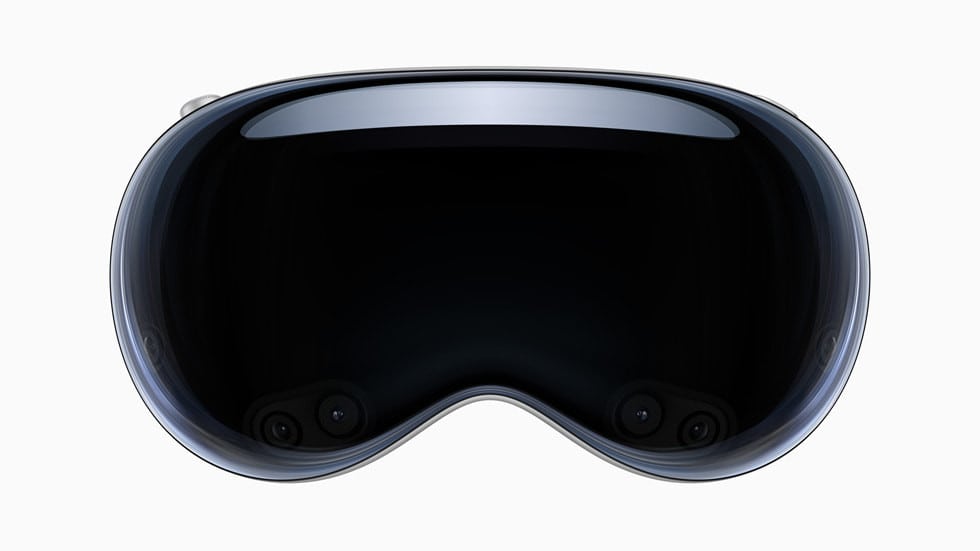
The Apple Vision Pro offers a sleek headset reinforced with an aluminum alloy frame. A black laminated glass spans the entire front area of the device. You’ll see the multiple high-resolution cameras and tracking sensors sitting underneath this glass. These components capture a 3D view of apps and media in the micro-OLED display.
Speaking of the display, the Vision Pro offers an impressive 4K resolution and a 120-degree field of view. If you have vision problems, the headset is compatible with custom ZEISS optical inserts. These prevent the need to wear glasses while using the spatial computer.
There is also a Light Seal to block stray light and ensure a fully immersive experience. Need to see more of the real world? The built-in digital crown dial lets you customize the level of immersion you want.
Finally, the two adjustable head straps (Solo Knit Band and Dual Loop Band) comfortably fit around your head. The headset even houses two embedded speakers for spatial audio.

In contrast, the Microsoft HoloLens 2 has an open design rather than the traditional enclosed headset look. It features a rotating visor-like form factor that contains the HoloLens sensors and displays. The sensors include four visible light cameras for head tracking and two IR cameras for eye tracking.
The brightness and volume buttons are near the visor, located near your left and right temple, respectively. These are easy to reach if you need to change the settings in the middle of an AR activity.
The visor connects to the headband. There is an adjustment wheel located behind the band for a customized fit.
Plus, the rear outer cover houses the power button and and USB-C port. The latter accepts a cable for charging or connecting the device to a computer.
Apple Vision Pro vs. HoloLens 2: Performance
The Apple Vision Pro boasts dual-chip technology. The first one is the Apple M2 chip, which is not your ordinary mobile phone processor. It can power Mac desktops, laptops, and the iPad Pro tablet. When used on a spatial computer, like the Vision Pro, the processor can handle advanced computer vision algorithms and ultra-HD graphics. The second chip is the brand-new R1. It can quickly stream data from the cameras, sensors, and microphones to the display goggles.
As for the operating software, Vision Pro uses visionOS. It is similar to macOS, iOS, and iPadOS. As such, Apple users will find familiar apps that are easy to navigate. The visionOS is also responsive to gesture controls and voice commands. It also supports the Apple Magic Keyboard, Mouse, and Trackpad.
Meanwhile, the Microsoft HoloLens 2 uses a Qualcomm Snapdragon 850 mobile compute chip. It offers fast graphics and processing speeds without draining the battery too quickly. It is also compatible with the Windows software, which is already pre-installed in the HoloLens device.
The HoloLens 2 also delivers 10-bit HDR video playback and streaming. The processor ensures high-fidelity surround sound and high-resolution image capture, even in low-light situations.
Besides immersive media playback, the Microsoft mixed reality headset also promotes collaborative work, increased productivity, and precise applications. It lets you connect with colleagues in real time and solve business issues using a holographic canvas.
Apple Vision Pro vs. HoloLens 2: Price and Availability
Both mixed reality devices come at steep prices, making them inaccessible to the average consumer.
The Apple Vision Pro retails at $3,499 in the United States. It will be available in the Apple store on February 2, 2024.
Meanwhile, the Microsoft HoloLens 2 has a price tag of $3,500 for the original and development version. The latter comes with the device itself and a three-month trial of the Unity Pro and the Pixyz Plugin.
The HoloLens 2 is also available in an industrial edition, which is priced at $4,950. Microsoft even offers a bundle with the Trimble XR10 ($5,199).
You can buy these HoloLens 2 bundles on the online Microsoft store or any authorized reseller.
Apple Vision Pro vs. HoloLens 2: Which One Is the Best?
Now that you know the major differences between the Vision Pro and HoloLens2, you may wonder which one is best.
The answer depends on your needs and preferences.
Apple advertises the Vision Pro as a spatial computing device with mixed reality capabilities. While it has impressive passthrough cameras, the enclosed headset design makes human interactions awkward. It is best used as a virtual reality device with the option to enhance the physical world through spatial video capture. It is also an excellent choice for media streaming and virtual gaming, owing to its 4K resolution.
On the other hand, the Microsoft HoloLens 2 is designed for businesses in mind. It is the better mixed reality headset, thanks to the rotating visor and see-through holographic lenses. There are also intuitive hands-free controls and advanced sensors for seamless interactions in the virtual world.
Plus, the HoloLens2 is compatible with the Microsoft ecosystem, from Windows and Cortana to Edge. It can even support different development programs to help you build games, movies, and engineering concepts in a virtual environment.
Conclusion
The Apple Vision Pro and the Meta Quest 3 are among the trending names in the world of AR/VR tech. Each one has its pros and cons, as I’ve covered extensively in this article. Choosing between the two virtual reality headsets ultimately depends on what you’re looking for and what you intend to achieve.
Do you have other questions about AR or VR headsets in general? Visit our blog page for other helpful information.