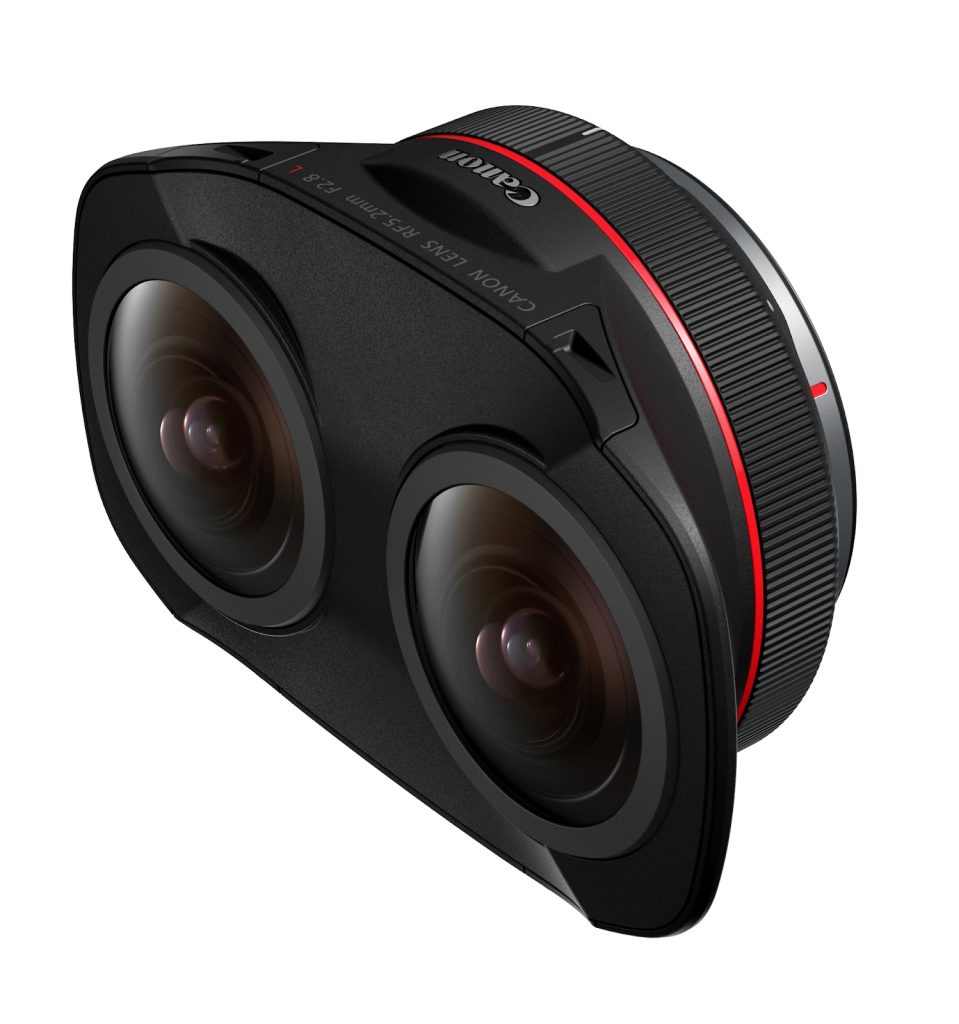
Are you finally intrigued by the new VR lens that Canon introduced? Perhaps you currently own a Canon EOS R5 and EOS R5C and need to see if the new Canon VR lens is worth buying? Making VR content has gotten more accessible in recent years and now Canon has introduced the world’s first interchangeable dual fisheye lens!
We think the Canon RF5.2mm F2.8 L Dual Fisheye Lens is worth the hype and it really is a game changer in the world of DLSR cameras. It can record up to 8K and the post-production process can be very smooth. No more having multiple files to create a 180º VR experience because this lens captures stereoscopic 3D VR imagery into one single image sensor.
In this article, we reviewed the features of the Canon RF5.2mm F2.8 L Dual Fisheye Lens. We also looked through a lot of user reviews to give you insight into what more people like and dislike about this product.
Canon R5.2mm F2.8 L Dual Fisheye Lens
Canon introduced the world’s first interchangeable dual fisheye lens last December 2021. As the name implies, it has two separate fisheye lens that records 3D images and videos for an immersive virtual reality experience.
Canon is definitely keeping up with the trend as VR is being used in a lot of industries, especially in recent years.
The new Canon RF5.2mm F2.8 L Dual Fisheye Lens has a lot of features that VR filmmakers wanted to try out.
Canon wanted creators “push artistic boundaries” [1] so they created the first-ever dual fisheye lens. With Canon’s EOS VR System, you can definitely level up how you film VR content for your audience.
The two lenses allow you to capture 180º on a wide angle, but also from top to bottom. This can really give your audience an immersive experience whether they are viewing from their VR headset, or in 2D from their computer or mobile devices.
Let’s take a look at the features of the Canon RF5.2mm F2.8 L Dual Fisheye Lens. And if this is THE lens that you should buy if you want to try your hand at making VR videos.
What’s Included in the Box
When you buy the Canon dual fisheye lens, aside from the lens, the box includes:
– Lens Case LS1014
– Lens Cap 5.2
– Lens Dust Cap RF
– Hexagon Wrench
Canon EOS VR System
With Canon’s EOS VR System, you can offer an immersive experience for your audience and level up your creativity through a stereoscopic 3D 180º camera lens.
Stereoscopic 3D with Canon R5.2mm F2.8 L Dual Fisheye Lens
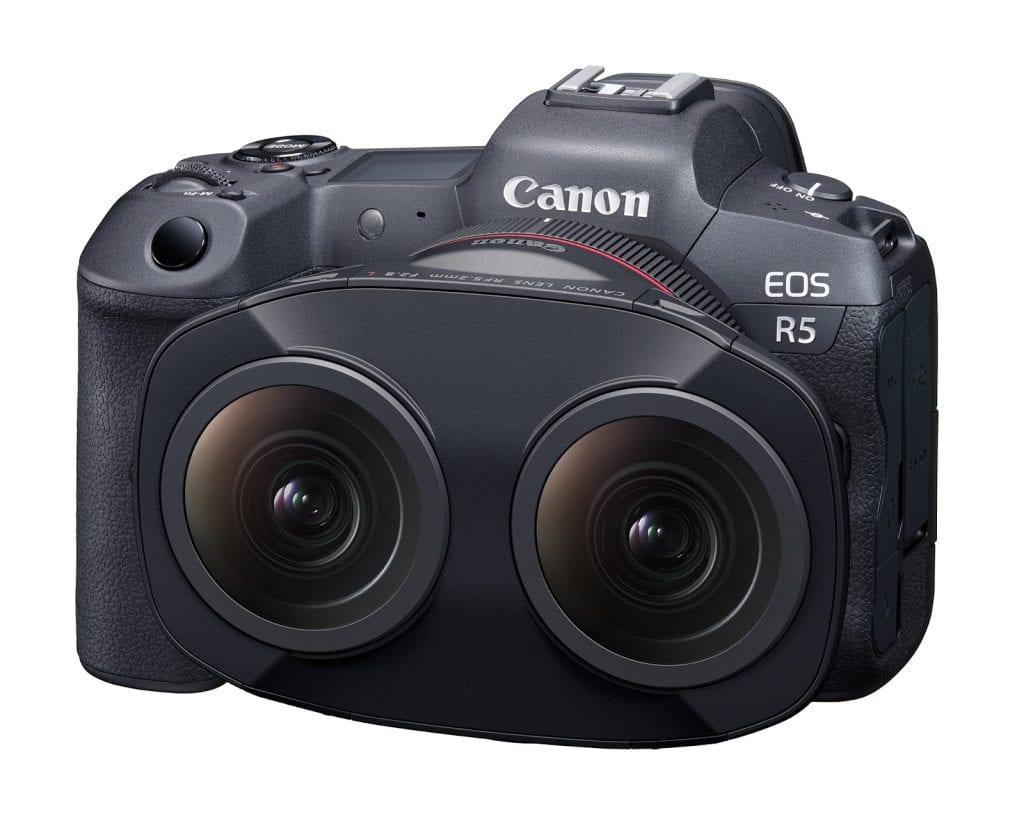
When they created their dual fisheye lens, Canon really had their customers in mind. With VR, it’s all about the immersive experience, and Canon wanted to “empower the next generation of immersive storytellers” with their new lens. [2]
Stereoscopic 3D imagery is not a recent discovery.
But, Canon’s RF5.2mm F2.8 L Dual Fisheye Lens streamlines the process of filming stereoscopic 3D imagery.
Multiple cameras are usually needed when shooting VR. They need to be perfectly aligned and synced to be able to stitch the footage together in post-production. The new canon dual fisheye lens allows you to capture stereoscopic 3D imagery into a single image sensor.
You don’t have to bring multiple cameras to film 180º VR imagery. The two lenses capture two different images and combine them together.
Both lenses cover a really wide angle so you have to plan ahead about how you would film. You want to make sure that there are no unwanted items or pieces of equipment that will be in your footage.
Since the 180º angle also covers the top and bottom, you might want to hide accessories like a boom mic or tripods.
If you are mounting your camera on a tripod, you have to be prepared to adjust the tripod as high as it goes so the stand is thinner, or just accept the fact that the tripod legs are going to be in your film.
You can work around it by jutting the camera forward so the lens does not capture the tripod legs. You want your viewers to have an immersive experience as if they are really there.
EOS Cameras with Compatible Firmware
The Canon RF5.2mm F2.8 L Dual Fisheye Lens is compatible with the Canon EOS R5 and EOS R5C. When paired together, you can expect to record up to 8K DCI at 30fps or 60fps.
This creates realistic imagery with excellent reproduction of detail and color.
You need 1.5.0 or higher firmware to capture VR with the EOS R5 while the EOS R5C can record VR natively. You can expect enhanced features when filming VR. This also adds the metadata information needed so the canon software can convert an image from fisheye to the main image format that 360º cameras use, or the equirectangular format.
Software Solutions

For post-production, Canon has a software available by subscription, Canon EOS VR Utility, which converts your video or images together in an equirectangular format.
You can edit, trim, and process your file to different formats and resolutions and formats with Canon’s EOS VR Utility. This way you can view your end product in compatible virtual reality headsets like Oculus Quest 2, Pico G2, as well as other platforms. When viewing in 2D on your computer or mobile device, you can use your mouse and click around the image to view other angles.
Aside from Canon’s software, you can also edit your videos in Adobe Premiere Pro. You need to download the EOS VR Plug-in to be able to convert your files in Adobe Premiere Pro.
What we found when using these software products is that it takes too long to export the recording into the software. If you have an older computer, you can expect hours of waiting time when exporting your files, especially if you have videos that go on for 30 minutes or so.
Make sure you have a computer that will be able to handle large files, especially when filming raw 8K footage.
Both the EOS VR Utility and Adobe Premiere Pro are paid but there is a free trial so you can try out the features before paying for anything. But if you are getting the Canon dual lens, you might want to invest in these tools to be able to edit your videos.
Features
Immersive Visuals
The Canon RF5.2mm F2.8 L Dual Fisheye Lens has 60mm interpupillary distance (IPD) spacing which is a close resemblance to our vision.
This really creates that illusion of being right there in the middle of where the scene was filmed. With this distance, you will be sure not to see any blurriness or distortion in the image. When viewed in HMDs (Head Mounted Displays), the 60mm IPD can also reduce motion sickness as the average IPD of a person ranges from 42mm to 75mm.
DUAL-LENS ELECTROMAGNETIC DIAPHRAGM
With both lenses having their own optic system, the aperture blade is accurate on both right and left lenses. It also has a coordinated aperture mechanism that controls the exposure of the lenses at the same time.
ND (Neutral Density) Filter
The Canon VR lens has a gelatin filter holder that allows you to use ND filters. ND filters reduce the amount of light that enters through your camera.
This allows you to be more in control when you select the shutter speed and aperture combinations in any condition, especially when filming outdoors.
Subwavelength Structure Coating (SWC)
Canon used a new coating technology to reduce ghosting, flaring, and any unwanted reflections in the footage. This is caused by light that is shining directly into the lens – whether that is natural light or artificial light sources.
Lens hoods are used to shade the lens and prevent the light source from shining directly to it, but the Canon RF5.2mm F2.9 L Dual Fisheye Lens does not have a hood so the SWC is used to reduce flares and reflections on your image or video.
Canon took a cue from insect eyes and other mechanisms in nature in order to have a non-reflective structure in their lens [3].
Dust and Drip Resistance
Camera lenses can be hard to clean, especially if you use them a lot.
To keep the Canon dual fisheye lenses easy to clean, it has a fluorine coating and it seals important points of the lens to prevent dust from building up. Fluorine coating repels water and oil so you can be at ease when you film in challenging conditions.
If you are into making VR content in different weather conditions, this is a good lens to have.
Field of view
The Canon RF5.2mm F2.8 L Dual Fisheye Lens lets you capture a stereoscopic 3D 180º image but it actually has a 190º field of view from both lenses.
This allows you to view the image beyond your initial field of view. For best viewing, it is best to use compatible headsets for a more immersive experience.
But, you can still view images or videos without a headset. You just have to view them in 2D on your computer or mobile. Facebook and Youtube are online platforms where some VR content is uploaded. You can use your mouse to navigate around the video.
Aperture
The RF5.2mm F2.8 L Dual Fisheye Lens has a large aperture range of F2.8 to F16.
In photography, F2.8 is a larger aperture while F16 is a lower aperture. This can be a little confusing at first as instincts say F2.8 should be the smaller aperture and vice versa.
But, when the aperture number is low, the wider the opening of the lens is. This allows more light to be able to reach the image sensor, resulting in a brighter image when you shoot in a low-light environment.
You have a wide range of options depending on where you are filming.
Image Quality
With a wide aperture of F2.8, you can expect sharp pixels from your image. Both lenses also have first-class optics and you can expect outstanding colors, clear images, and minimal color distortion.
Since the RF5.2mm F2.8 L Dual Fisheye Lens can record up to 8K DCI with a resolution of 8192 x 4320, you can give your viewers a really good VR experience.
In post-production, you can lower the resolution to 4K if the files are taking up too much space and slowing up your editing process. With 4K resolution, you can still get amazing end results without compromising the quality of your image or video.
Most modern TVs and monitors also have 4K resolution so your audience will not miss out on high-end graphics.
Focusing
The Canon RF5.2mm F2.8 L Dual Fisheye Lens has a manual focus band which can let you control how sharp your images are.
The manual focus band adjusts both right and left lenses at the same time but, you can also adjust the lenses separately. You can adjust the lenses separately using the hex key wrench that is included when you buy the lens.
You manually focus each lens with a separate Left-Right Focus Difference Dial.
If you like having an auto-focus capability, this lens will not be for you as it only offers a manual focus operation.
Portable
The RF5.2mm F2.8 L Dual Fisheye Lens is smaller than the regular DLSR (Digital Single-Lens Flare) camera lenses that you normally see.
It has a dimension of 2.11″ in length, 4.77″ in width, and 3.29″ in height. It’s definitely not long like the usual lenses.
The dual fisheye lens is easy to carry and will fit easily in your camera bag. Since this is a digital interchangeable lens, you can easily go from traditional filming to VR shooting. Just make sure to pair the dual fisheye lens with either the EOS R5 or EOS R5C.
You don’t need to bring multiple cameras in order to record immersive experiences for your audience. It is a compact, lightweight, and portable lens that you can bring anywhere.
Where to buy

You can buy online directly from the Canon website or Amazon. Check the price for this Canon VR Lens on Amazon.
Remember: you also need to buy an EOS R5 or EOS R5C mirrorless camera if you don’t have one already.
Social Proof
Since the Canon RF5.2mm F2.8 L Dual Fisheye Lens is only a year old, there are a lot of users who have bought and tried this lens.
It is the first dual fisheye lens that can record stereoscopic 3D 180º VR imagery making it more interesting to a lot of people.
We spent a few hours looking through a lot of user reviews. We found that the Canon VR lens is very easy to handle and it is easy to use the manual focus operation to adjust both left and right lenses separately.
Users liked how easy the post-production is. They like how streamlined and smooth the process is and how you don’t have to stitch multiple video files to create one image or video.
Users also like how canon introduced using DLSRs in creating VR content. With the Canon VR lens, you don’t need to buy a full VR camera to create VR content.
But, we also want to talk about what some users did not like about the Canon VR lens.
Since the lens is only compatible with the Canon EOS R5 and EOS R5C, Canon users who don’t have said camera bodies find it limiting. Since the Canon RF5.2mm F2.8 L Dual Fisheye Lens is a Canon brand, they wanted it to also be compatible with other Canon camera bodies.
One user commented how the R5 overheated after 15 minutes of recording in 8K. So, you might want to keep that in mind while filming.
Frequently Asked Questions (FAQs)
What is the point of a dual fisheye lens
A dual fisheye lens is designed for immersive 180º virtual reality content. You can view VR content with either compatible VR headsets or in 2D – viewing through your computer browser or mobile.
Some compatible VR headsets for viewing VR content made with the new Canon VR lens are Oculus Quest 2 and Pico G2.
Do fisheye lenses make things bigger?
Since fisheye lenses usually capture a wide 180º angle, it creates a distortion that can make things appear bigger. The circular distortion causes the image to appear bigger than it actually is.
Wrap up
With recordings up to 8K and an easy post-production process, we think that the Canon VR lens is worth buying. Especially if you already have the Canon EOS R5 and EOS R5C.
There might be a lot of learning curves when it comes to making VR content and using the Canon VR lens. But, we hope this article helped you decide if it is something you would like to buy.
Don’t hesitate to ask us any questions via our contact form. We’d love to hear from you!