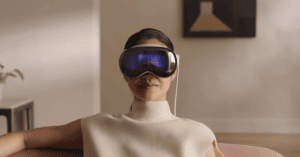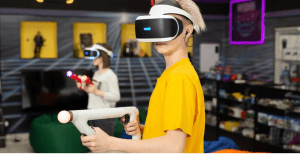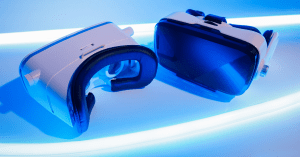
Virtual Reality, or VR, is a technology that allows users to experience simulated environments. This can be done through the use of special headsets that allow you to see and interact with virtual objects as if they were real. These VR headsets are also called Head-Mounted Displays, or HMDs.
There are many different VR headsets on the market, each with its own features and capabilities. In this article, we will explore what VR headsets are, what they do, and give examples of some of the most popular ones on the market.
What is virtual reality
If you want to know more about what virtual reality is and how VR works, check out our separate article here that covers this in more detail.
Basically, virtual reality (VR) refers to the use of computers to generate simulated environments that can be experienced by users of VR technology. This allows users to feel as if they are inside the virtual world, and interact with it in a realistic way.
A virtual reality headset is one technology that can be used to deliver an immersive virtual reality experience, but there are other possibilities as well (for example, a room with displays projecting images around the room to fill the user’s field of view.
There are many uses for VR, from gaming and entertainment to training medical students in surgical procedures. If you want to know more about current and future applications for VR technology, check out our separate article here.
How do VR headsets work?
Replacing the real world with a computer-generated environment
A VR headset is typically like a mask that you wear over your eyes and ears. This mask blocks out the real world and replaces it with computer-generated images and sounds. The images and sounds are generated by a computer and sent to the VR headset.
Delivering stereoscopic images
For realistic three-dimensional VR experiences, it is important to generate stereoscopic images. This means creating two separate images, one for each eye. Each image is slightly different because in the physical world our two eyes are located in slightly different positions. This difference is called parallax, and it allows our brain to reconstruct the three-dimensional scene.
Virtual reality headsets then typically display the images to the user using separate displays for each eye. The VR headset then uses lenses to focus these images in front of your eyes. This creates the illusion that you are inside the virtual world. The optic quality, display resolution, and image clarity can make a big difference in the VR experience, so choosing the best VR headsets can make a big difference vs. entry level models.
The refresh rate of the display, or how fast it generates new images when the VR environment changes is also important. When a user’s head moves, the VR headset should refresh the image as fast as possible, typically at least 90 times per second. A slower refresh rate can increase the risk of motion sickness or cybersickness, which can be a side effect of VR for some users.
Delivering stereo sound
In the real world, our ears are used to sounds coming from different locations, depending on where the sound is originating. To create a realistic VR experience, it is important to generate stereo sound, meaning two separate audio tracks that are played back through headphones or earbuds. The slightly different timing and location of the sounds creates a three-dimensional auditory scene.
Tracking motion & orientation of the head
Tracking your head movement is another important feature of a VR headset. This is how the computer knows where you are looking, so it can generate the appropriate image. This is usually done with some combination of an accelerometer, gyroscope, and magnetometer.
Some VR headsets also track the position of your head in space, so you can walk around and explore the virtual world. This is called room-scale VR, and it may require special hardware to track your position.
Connection to Other VR Controllers for Motion & User Input
Many VR headsets also feature wireless connections to other input and motion controllers that can track the location of your hands, feet, or even your full body.
For example, the HTC Vive and Oculus Quest both come with a motion controller that allows you to interact with the virtual world. These handheld controllers may have buttons, touch pads, or joysticks that allow you to perform different actions within the VR environment.
Virtual Reality Software
The VR hardware in your virtual reality headset can’t deliver immersive experiences without VR software. Whether for VR gaming, training, or just virtually chatting with friends, the VR app (application) running on your device is just as important as the hardware to enable great virtual reality content that feels immersive and easy to use.
Different types of VR headsets
Computer-Tethered vs. Standalone Headsets
The computer itself may be separate from the VR headset, and connected to it by wires, in which case it is called a tethered headset. The VR headset can also have its computer hardware built-in within the head-mounted device so that it can operate without wires. This type of headset with embedded computing power to generate the virtual is called a standalone headset.
Standalone headsets are especially convenient for exploring virtual worlds because of the ability to move around without tripping over a cable tethered to a PC. These types of VR systems make it a lot easier to explore VR environments.
VR Headsets Connected to Gaming Consoles
Some headsets can even use a game console instead of a personal computer to create the computer-generated environment. For example, Playstation VR works with the Playstation 4 console, and there is also a VR kit for the Nintendo Switch.
VR Headsets Driven by Mobile Devices
Another type of headset is one that uses the display of a smartphone or other mobile device to generate the VR simulation. Typically the phone will be turned sideways and mounted inside a headset. The phone then generates the VR visuals, and lenses in the headset help focus the view based on the location of the user’s eyes.
An advantage of this type of device is its low cost, with Google Cardboard and Samsung Gear both being examples. However, the VR experience that can currently be achieved with this type of headset tends to be much lower quality than what can now be achieved with standalone VR headsets, and for this reason this style of device has declined in popularity in the past 1-2 years.
Augmented Reality Glasses (sometimes called VR Glasses)
Another concept related to headsets is the idea of augmented reality glasses, which are sometimes incorrectly called “VR glasses”. These are see-through glasses that have a display built into them, but instead of generating a computer-generated environment, they provide information or images that are overlaid on top of the real world around you.
One early example was the Google Glass device, which was designed to provide information like text messages or turn-by-turn directions. Another example is Microsoft HoloLens, which is being used for training by the US Army, and has potential applications in design and gaming.
While AR and VR are sometimes confused, it’s important to remember that they are two very different things. AR adds digital information on top of the real world, while VR creates a completely artificial environment that replaces the real world.
Examples of Popular VR Headsets Currently on the Market
As of Fall 2022, the list below highlights some of the VR headsets that are most widely used. These VR devices tend to have more VR games and other VR content available given their popularity.
Mass Market Consumer VR Headsets
• Meta Quest 2 (formerly Oculus Quest 2, as Oculus VR now owned by Meta/Facebook)
• HP Reverb G2
• Sony Playstation VR headset
Higher Price Headsets (over $550)
• HTC Vive Pro 2
• Valve Index VR HMD
• Pimax Vision 8k
• Pimax Vision 5k
• Microsoft HoloLens 2 (augmented or mixed reality, not pure virtual reality)
Entry Level VR headsets (under $200)
• Switch VR Headset (for Nintendo Switch)
• Google Cardboard
Examples of Popular VR Headsets No Longer Manufactured
• Oculus Rift
• Oculus Quest 1
• Samsung Gear VR
• Google Daydream View