When my aunt and uncle were looking for a new house to move in, they looked at several houses for a couple of months. I even joined them in several open-house viewings.
When I went with them to these open houses, we spent the day driving around to different areas. We looked at a house, spoke to an agent, finished the tour, and went to another location. Rinse and repeat. It was a little bit tiring and time-consuming, to be honest.
With our technology today, it is possible to do all of that in the comfort of your own home. With virtual reality and VR headsets, you can now view houses virtually from anywhere. And, if you are a real estate agent, you can organize multiple open houses and tours virtually as well. You can also use VR in real estate marketing.
This article will look at the ways both buyers and agents can use virtual reality to optimize their house hunting and selling. I looked up studies to see how virtual reality is used for real estate, its benefits, and its drawbacks.
If you are also interested in investing in real estate, I also covered it in the first part of this article. But, if you are looking to buy a property, sell one, or are just interested in viewing houses, virtual reality tours might be for you!
Impact of the Metaverse on the Real Estate Industry

Metaverse, Virtual Reality (VR), Augmented Reality (AR), and Mixed Reality (MR) have been around for decades.
It is not a recent discovery that has shocked the world. But, with technology being more advanced, the rise in popularity of VR, AR, and MR has impacted a lot of people’s lives, different industries, and our world in general.
The popularity of Metaverse and the advanced technology of today opened up a lot of opportunities and continue to do so in the coming years.
Fashion brands, Retail, Music and Entertainment, and other industries have used VR technologies to give more experience to their consumers [1]. These industries have definitely seen how virtual reality can impact their brand and how they can reach people.
The Real Estate industry is no different.
The Real Estate business has also joined the mix of industries that are tapping into the Metaverse. Many people are now investing in virtual real estate, even buying and selling lands on different Metaverse platforms.
The Sandbox, Decentraland, and CryptoVoxels are just some of the platforms where you can buy and sell virtual lands [2].
In these digital spaces, you have free rein on the design and how you can monetize these lands. But mind you, these digital spaces can cost you a lot of time and money. Creating virtual lands is not as easy as you think and don’t expect the cost of buying one to be cheap either.
VR in Real Estate

But, what about people who do not want to invest in a virtual property and just want to buy a physical house somewhere?
Most people do not want to rely on photos when buying a property and some do not have the time to arrange for a property visit with a real estate agent.
This is where virtual reality in real estate comes in. Virtual reality technology is not just for buying and selling lands and properties.
Most real estate developers have started using VR technology. According to the 2020 Augmented Reality and Virtual Reality Survey Report by Perkins Coie, commercial and residential real estate was anticipated to use VR or AR technology in 2021 [3].
With 2023 in sight, we can say that virtual reality has definitely left its mark on the real estate industry, and will continue to do so in years to come.
Most real estate agents have started using VR to showcase properties to potential buyers and tenants. 360-degree videos are just one of the ways to use VR in real estate.
Use of VR in Real Estate

Aside from the virtual aspect of buying and selling lands and properties, VR has become a tool for real estate agents to be able to give potential buyers an opportunity to take interactive virtual home tours.
Here are some of the ways VR is used in real estate:
Property visits
As a potential house buyer, you would always want to view different properties when buying or renting.
Property visits can let you know if there are issues in the house or if the neighborhood where it is located in a place you want to live in.
VR technology made it possible to view houses in the comfort of your home. To make your virtual tour immersive, you have to use a virtual reality headset.
Most VR headsets like the Oculus Quest 2 and HTC Vive are popular for gaming, but they can also be used in other VR platforms.
There are guided tours and interactive visits that companies use for showcasing their properties.
Guided tours are usually 360-degree videos that are shot using a 360-degree camera. While interactive tours are fully immersive 3D environments where you can interact with the space, go in rooms you like, and even change the wallpapers of the house.
Architectural visualization
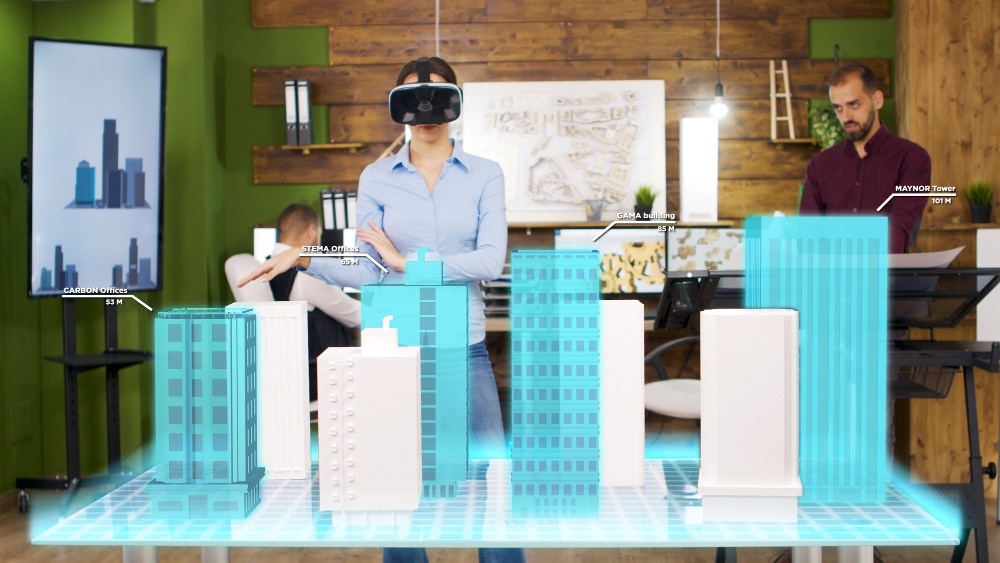
With VR technology, you will be able to see what the whole property looks like.
This is helpful with properties that are not yet complete or haven’t been built yet. Real estate companies can show you a 3D render of the finished project and can even show the interior of the house or building.
Apartments or condominiums that are pre-selling usually use this method to attract potential buyers.
I have actually toured a pre-selling condominium using their guided tour. It is not a fully immersive VR experience as I did not use a VR headset but, I was able to see how the building will look once it is finished and I was able to view different units and based my decisions based on what I saw.
House Staging
Staging is probably one of the important aspects of real estate. It is putting and styling furniture in a house or property that is being sold. It does not come with the house when you buy it.
When I was looking for properties on the internet, I found myself mostly looking longer at houses that have furniture in them. Staging can make the house more inviting and you can gauge what kind of furniture you have that can and can not fit in that particular house.
Staging is not only done in real life. It is also possible in virtual reality. House staging done in VR can really make it more realistic.
Companies such as Virtual Staging Properties, Rooomy, and VSH Media provide virtual staging services to real estate clients.
Virtual Commerce
Visual commerce, or V-commerce for short, can add to the experience of a VR real estate house tour.
If there is staging involved real estate agents or brokers can add the option of letting customers change and replace the pieces of furniture. Or, have potential buyers place furniture in empty houses by having an online store option.
Benefits of VR in Real Estate

Let’s look at how VR technology benefits the real estate industry and its potential buyers.
Saves time
VR can save time for both the buyer and the real estate agent. Both parties do not have to go to a physical location to be able to show off and see a property.
Open houses and property viewings can also be done at any time without the agent having to go to multiple listings. Potential buyers can just use their VR headsets to tour a property when they want.
Of course, if you want to ask questions regarding a property, you can organize a virtual tour with a real estate agent so they can help with your questions.
If you do not have a VR headset, you can still tour properties in 2D with 360 video house tours.
Staging can also be done more efficiently as an agent does not have to get real furniture to put in properties that they are selling.
Realistic VR tours
With today’s technology, we can now view a property even though it is not finished yet. 3D technology allows for the photorealistic rendering of objects making them more realistic.
This can make you feel like you are touring a physical property instead of a 3D space.
But, there are house tours that are shot with a panoramic camera. Real estate agents usually use this for pre-owned houses as there is already a complete property to show.
Wide reach
There are a lot of people in different areas, cities, and even in different countries looking for a house to buy or rent.
For real estate agents or brokers, setting up virtual tours for these clients can mean that they will be able to see the house even when they are far away.
Let’s admit that sometimes pictures just do not do the place justice. Also, photos can sometimes be edited to make the place look amazing even when it is not.
With virtual reality, property tours can reach a wider audience.
Reduced cost
Aside from saving time, buyers and agents can also reduce costs when using VR in real estate.
If you are selling a property that is newly built or pre-owned, you do not need to do any special 3D equipment to make your VR house tour.
For a 360 video, you only need a panoramic camera and knowledge of 360-video editing software. This can make your VR tour immersive for potential buyers.
For potential buyers, you can save money on gas or commute fees.
Drawbacks of VR in Real Estate

VR definitely has presented an opportunity to the real estate industries but, there will always be disadvantages even with the most advanced of technologies.
Cost
So, how can cost be a drawback when you can reduce cost with VR?
While real estate companies, agents, and brokers can see money by doing 360 videos on new or pre-owned properties, it can be an expensive venture when doing VR tours on projects that are still in the development phase.
There are a lot of factors that go into creating 3D spaces. A real estate company needs to hire a 3D artist, virtual staging companies, and provide other support or equipment needed to make a realistic representation of a house.
While big companies might have the budget for this, small real estate companies and independent agents and brokers may not be able to provide the same service to their clients.
No real-life interaction
While one may argue that you can always visit the house you will buy after a virtual tour, it can still be hard to compare houses that you have not seen physically.
For pre-owned houses, it might still be better to inspect the place yourself to check for damages or inconsistencies with the properties. But, of course, you can still ask the real estate agent about those things in a virtual tour.
Need for VR headset and other equipment
If you want a fully immersive VR experience, there is no other way but to use a VR headset.
The same goes for viewing VR property tours. While you can view it on your computer browser and use your keyboard and mouse to navigate around the space, you won’t fully immerse yourself in the VR house tour without a headset.
If you do not have one, it’s going to cost you a couple of dollars to buy one.
While a good investment, for smaller companies and independent agents, buying a panoramic camera to film VR tours might be out of their budget.
Wrap up
Potential buyers now have the choice to go to open houses physically or opt to do a virtual tour without ever having to leave and travel to different locations.
There are a lot of possibilities with VR and it can create more opportunities to do new things in the next years to come. With advanced technology, VR can only get bigger and better.
Real estate and other industries will have to keep up with new technologies to create more experiences for their clients and find ways to make the buying process smoother for everyone.
VR is definitely not for everyone but, we hope this article was helpful in understanding how VR can be used in the real estate industry.
If you have any questions, please do not hesitate to reach out to us via the contact form on our website.